
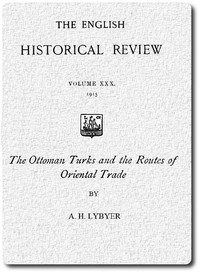
The Ottoman Turks and the Routes of Oriental Trade by Albert Howe Lybyer
Forget the simple story of conquest. Albert Howe Lybyer's book presents the Ottoman Empire's rise as a masterclass in economic strategy. Published in the early 20th century, this work shifts the focus from palace intrigue and military campaigns to the critical, often-overlooked engine of empire: trade.
The Story
The book's central idea is that the Ottomans didn't just accidentally find themselves on top of the world's most important trade routes—they actively seized and managed them. Lybyer traces how, from the 15th to the 17th centuries, the empire controlled the vital land and sea paths connecting Europe with the riches of Asia. He shows how this control over the spice and silk trades wasn't a side effect of their power; it was a primary source of it. The wealth flowing through Istanbul funded their armies and built their grandeur. The narrative follows how European nations, tired of paying Ottoman tolls and markups, were eventually forced to seek new sea routes around Africa and across the Atlantic—a quest that accidentally reshaped the entire globe.
Why You Should Read It
What makes this book stick with you is how it connects big, abstract forces to real human history. You start to see Columbus and Vasco da Gama not just as brave explorers, but as men reacting to an Ottoman economic blockade. It gives you a 'behind the scenes' look at history, where geography and economics are the main characters. Lybyer’s research, though old, laid the groundwork for how we understand this period. Reading it feels like getting the missing piece of a puzzle, explaining why certain cities flourished and why entire continents were 'discovered.' It turns the Ottoman Empire from a distant, exotic power into a brilliant, calculating business manager of its age.
Final Verdict
This is a perfect pick for anyone who loves history but wants to look beyond kings and dates. It’s for the reader who enjoys 'connector' books that show how trade, geography, and politics weave together to create the world we know. Be warned, it's a scholarly work from 1915, so the prose can be dense in places—it’s not a breezy beach read. But if you're patient, the insights are incredibly rewarding. Think of it as the foundational text for understanding how the desire for pepper and cloves helped map our modern world.
This title is part of the public domain archive. You do not need permission to reproduce this work.
Charles Gonzalez
2 weeks agoThe clarity of the concluding remarks is very professional.
Joseph Harris
1 year agoI was particularly interested in the case studies mentioned here, it manages to maintain a consistent flow even when discussing difficult topics. I’ll definitely be revisiting some of these chapters again soon.
Elizabeth Young
4 months agoThis is one of those stories where it manages to explain difficult concepts in plain English. Worth every second.
Sarah Perez
3 months agoSolid story.






Linda Jackson
3 months agoFrom a researcher's perspective, the formatting on mobile devices is surprisingly crisp and clear. Highly recommended for those seeking credible information.