
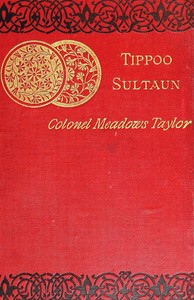
Tippoo Sultaun: A tale of the Mysore war by Meadows Taylor
Let's set the scene: India, in the late 1700s. The British are pushing inland from their coastal settlements, hungry for power and trade. Standing in their way is Tipu Sultan, the fierce and clever ruler of Mysore. He's not just a local king; he's a formidable opponent with modern armies and big ambitions. Meadows Taylor's novel drops us into the middle of their explosive confrontation, known as the Anglo-Mysore Wars.
The Story
The plot centers on Philip Dering, a young British officer. During the brutal fighting, Philip is captured by Tipu Sultan's forces. Instead of being thrown in a dungeon, he finds himself in a strange new position. He's brought into the Sultaun's court, a place of incredible intrigue, splendor, and danger. From this unique vantage point, Philip witnesses the war not as a distant campaign, but as a personal drama. He sees Tipu not just as a 'savage enemy' from British pamphlets, but as a complex, strategic, and sometimes ruthless leader fighting for his kingdom's life. The story becomes Philip's journey as he navigates loyalty, survival, and his own changing understanding of the world.
Why You Should Read It
What grabbed me was how fresh this 19th-century novel feels. Taylor, who actually lived and worked in India for decades, doesn't give us simple heroes and villains. Tipu Sultan is a magnetic character—proud, innovative, and brutal, all at once. You understand his defiance, even as you see its costs. Through Philip's eyes, we experience the confusion and moral ambiguity of colonial conflict firsthand. The book is packed with tense escapes, courtly schemes, and battlefield chaos, but it's the human element that sticks with you. It makes you think: in a war for empire, where do right and wrong actually stand?
Final Verdict
This is a perfect pick for anyone who loves a grand historical adventure but wants more than just swordfights. It's for readers curious about the real people behind the history-book headlines, especially the compelling figure of Tipu Sultan. If you enjoyed the immersive feel of Bernard Cornwell's Sharpe series or the cultural complexity of Amitav Ghosh's novels, you'll find a fascinating ancestor here. Just be ready for a story that pulls no punches about the realities of war and leaves you with plenty to ponder long after the last page.
This publication is available for unrestricted use. You do not need permission to reproduce this work.
Mary Wilson
9 months agoThe clarity of the introduction set high expectations, and the author manages to bridge the gap between theory and practice effectively. A rare gem in a sea of mediocre content.
Mary Jackson
4 months agoThe clarity of the introduction set high expectations, and the attention to detail regarding the core terminology is flawless. It’s a comprehensive resource that doesn't feel bloated.
Jennifer White
2 years agoAfter a thorough walkthrough of the table of contents, the way it handles controversial points with balance is quite professional. A refreshing and intellectually stimulating read.








Charles Jackson
1 month agoGiven the current trends in this field, the language used is precise without being overly academic or confusing. An excellent example of how quality digital books should be formatted.