About 240 minutes
Dwell Deep; or, Hilda Thorn's Life Story — Reading Companion
Young Readers Enchanted Adventures
55,192 recorded words. 3 minutes difference from this book's estimate.
View Gutenberg source #22243
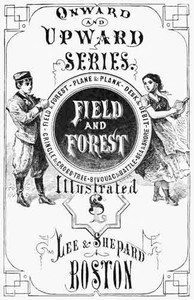
Before opening Field and Forest; Or, The Fortunes of a Farmer — Inside the Classic, the edition data offers a quick orientation: 55,834 words, 4 hr 3 min estimated reading time, and 7 detected text sections.
The text analysis averages about 15.1 words per sentence, while the detected sections provide another way to judge how the source is divided.
Project Gutenberg metadata also associates the work with “Christian life -- Juvenile fiction,” connecting these edition facts with the source record’s subject description.
Explore this collection
These alternatives are selected using recorded categories and estimated reading time.
About 240 minutes
Young Readers Enchanted Adventures
55,192 recorded words. 3 minutes difference from this book's estimate.
View Gutenberg source #22243About 246 minutes
Young Readers Enchanted Adventures
56,562 recorded words. 3 minutes difference from this book's estimate.
View Gutenberg source #33221About 248 minutes
Young Readers Enchanted Adventures
56,928 recorded words. 5 minutes difference from this book's estimate.
View Gutenberg source #26538Search stored excerpts and compare books → Choose by your preferences →
Choices use stored catalog measurements. Estimates vary with reading speed. A shared category is a catalog label, not a claim that two books have the same argument or literary quality.
Search reads excerpt text stored with this catalog and links to its associated Gutenberg record. The connection is stored in the site database; this tool does not recheck that every excerpt is word-for-word identical to that external record. Excerpt search does not cover every chapter and does not verify historical publication dates.
Catalog snapshot checked: 2026-09-25. Coverage: 99 public books, 99 available source excerpts.
Calculated from edition completeness, EPUB availability, text structure and catalogue metadata. Not a user rating.
Total of 100 points, scaled to a 2.5-5.0 range. Editions with an empty description or a missing EPUB file are not scored.
Public-domain source text
The source text is kept in the dedicated reader, separate from this catalogue record and its commentary.
Oliver Optic's Field and Forest; Or, The Fortunes of a Farmer opens with a dedication to a young friend and a preface that frames the story as the first of the Upward and Onward Series, promising a hero of high aims. The excerpts reveal a narrative voice that blends colloquial dialect—Kit Cruncher's 'thyer,' 'skeered,' 'mought'—with the more formal speech of protagonist Phil Farringford. This contrast in diction immediately establishes a social and experiential divide between the seasoned frontiersman and the principled youth, a dynamic that drives much of the tension in the selected passages.
Kit Cruncher's speech is rendered with consistent nonstandard spellings: 'gal,' 'hyer,' 'cal'late,' 'resk.' This is not merely decorative; it signals his practical, unschooled wisdom. When he reassures Ella, 'Don't be skeered, little gal,' the tender tone is amplified by the homely phrasing. Phil, by contrast, uses standard English, even in crisis: 'We can't go down Fish River to-night.' The author uses this linguistic divide to underscore Phil's book-learned morality versus Kit's experiential knowledge. Notably, the narrator does not comment on the dialect; it is presented as natural, leaving readers to infer character from speech alone.
Optic rarely pauses for scenic description. Instead, the landscape emerges through the characters' movements: 'We carried the light barge across the tongue of land, and launched it in the Big Fish.' The geography of the Big and Little Fish Rivers is revealed as the characters portage the boat, not in a set-piece paragraph. Similarly, danger is conveyed by sensory details—'a third shot came across the river,' 'the last bullet hit the boat'—rather than abstract fear. This technique keeps the narrative pace brisk and aligns with the adventure genre, but it also means that setting is always functional, always tied to the characters' immediate goals.
The excerpted dialogue serves dual purposes: advancing the plot and revealing inner states. When Kit says, 'We can't go down Fish River to-night; that's all that's sartin,' he both states a fact and models a pragmatic acceptance of limits. Phil's response—'That is very true'—shows his deference to Kit's judgment. Ella's frightened query, 'Can't the savages come over here?' is answered not with false comfort but with a rifle-ball metaphor: 'Rifle-balls travels fast.' The author uses such exchanges to dramatize problem-solving under pressure, while also hinting at the emotional weight carried by each character. The dialogue rarely feels expository; it is always grounded in the immediate predicament.
The preface explicitly states Optic's intent: to make his hero 'a young man of high aims and lofty purposes' and to show 'an Upward and Onward progress.' This moral framework is visible in the excerpts, where Phil's decisions are guided by principle—he aims to protect Ella and act prudently. Yet the narrative voice does not preach; it lets actions speak. When Phil says, 'I realized that it would not be an easy matter to find the soldiers,' the reflection is practical, not pious. The authorial hand is most visible in the careful orchestration of peril and escape, but it remains behind the scenes, allowing the characters' choices to carry the moral weight.
Readers approaching Field and Forest will find a story that moves quickly, driven by dialogue and action rather than introspection. Optic's choices in diction—especially the contrast between Kit's dialect and Phil's standard English—reward attention, as they subtly encode character and experience. The excerpts suggest a narrative that balances adventure with moral instruction, but the instruction is woven into the fabric of the plot, not delivered as sermon. For those interested in nineteenth-century juvenile fiction, this work offers a clear example of how authors of the period used language and structure to shape both story and character.
I remember plowing hours into my uncle's dusty hardcovers, the Missouri heat seeping through the pages. The way Optic's spare diction lets the frontier air feel real—quiet, determined. 'Me and Nobbles' — Reading Companion once gave me that same slow warmth, a boy’s small adventure holding the whole world still, like a breath before supper.
Answer a few questions and save a private reflection on this device.