About 289 minutes
Soldiers of the Queen — Text and Context
Technology Airships Imagined Futures
66,428 recorded words. 5 minutes difference from this book's estimate.
View Gutenberg source #29415
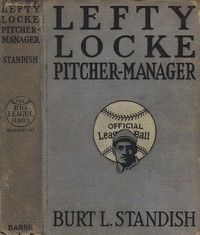
For Lefty Locke, pitcher-manager — Themes and Context, the stored edition analysis reports 67,544 words, 4 hr 54 min estimated reading time, and 7 detected text sections.
The text analysis averages about 14.6 words per sentence, while the detected sections provide another way to judge how the source is divided.
Project Gutenberg metadata also associates the work with “Swindlers and swindling -- Juvenile fiction,” connecting these edition facts with the source record’s subject description.
Explore this collection
These alternatives are selected using recorded categories and estimated reading time.
About 289 minutes
Technology Airships Imagined Futures
66,428 recorded words. 5 minutes difference from this book's estimate.
View Gutenberg source #29415About 285 minutes
Technology Airships Imagined Futures
65,388 recorded words. 9 minutes difference from this book's estimate.
View Gutenberg source #31870About 269 minutes
Technology Airships Imagined Futures
61,829 recorded words. 25 minutes difference from this book's estimate.
View Gutenberg source #36010Search stored excerpts and compare books → Choose by your preferences →
Choices use stored catalog measurements. Estimates vary with reading speed. A shared category is a catalog label, not a claim that two books have the same argument or literary quality.
Search reads excerpt text stored with this catalog and links to its associated Gutenberg record. The connection is stored in the site database; this tool does not recheck that every excerpt is word-for-word identical to that external record. Excerpt search does not cover every chapter and does not verify historical publication dates.
Catalog snapshot checked: 2026-09-25. Coverage: 99 public books, 99 available source excerpts.
Calculated from edition completeness, EPUB availability, text structure and catalogue metadata. Not a user rating.
Total of 100 points, scaled to a 2.5-5.0 range. Editions with an empty description or a missing EPUB file are not scored.
Public-domain source text
The source text is kept in the dedicated reader, separate from this catalogue record and its commentary.
Burt L. Standish opens Lefty Locke, Pitcher-Manager with a porch-side conversation under moonlight, where the villain Weegman is introduced through two repetitive mannerisms: he is “always chuckling or laughing outright” and snaps his fingers—both described as “monotonous” and “irritating” by the protagonist. This early emphasis on physical tics establishes Weegman as a grating, untrustworthy figure without explicit moralizing. The setting is equally deliberate: frogs chorusing and a distant dynamo drone create a rural, slightly ominous soundscape that contrasts with the urban baseball world to come.
Standish’s word choices often reinforce power dynamics. When Weegman claims “full instructions and authority,” the phrase carries legal weight, yet his admission that “tinware for Kennedy” is “poor slang” reveals a character who performs sophistication but slips. Lefty’s response—“I could scarcely believe you meant just that”—uses formal, measured language that signals his skepticism and self-control. The narrator later describes sportswriters as “wise pen pushers” whose opinions are followed by “little fellows, who ran, bleating, after the wise one, like a flock of sheep chasing a bellwether.” This simile, with its agricultural imagery, dismisses the press as unoriginal and herd-like, aligning the reader with Lefty’s independent judgment.
Conversations in the excerpt rarely convey straightforward information; instead, they reveal character through evasion and implication. Weegman’s chuckling and finger-snapping are not just habits but rhetorical devices that deflect seriousness. When Lefty asks for clarification, Weegman replies with a laugh and a cigar puff—nonverbal cues that undermine his words. Later, Lefty’s telegram from Kennedy reads simply: “Good work! Congratulations. Keep it up. Kennedy.” The brevity and lack of detail suggest coded communication, hinting at a conspiracy that the text does not fully explain. Standish uses dialogue to create a sense of hidden agendas, where what is unsaid matters as much as the spoken lines.
Standish builds atmosphere with sparse, functional details. The opening scene includes “soft, bright moonlight,” frogs, and a dynamo’s “nocturnal droning”—elements that establish time and place while subtly foreshadowing tension. Later, Lefty’s hurried movements through New York are summarized: “he was kept on the jump, without time, even, to snatch a hasty lunch.” This plain statement conveys the pressure of his dual role without melodrama. The narrator also notes that Lefty “did not relish running away from Weegman,” using the verb “relish” to emphasize emotional distaste rather than fear. Such choices keep the prose grounded in action and internal reaction, avoiding excessive sentiment.
The excerpt cuts between dialogue, interior thought, and logistical planning, creating a rhythm of tension and release. Lefty’s decision to visit his parents is a rare moment of personal respite, but it is quickly undercut by the failed attempt to contact Franklin Parlmee and the missed train. Standish uses time constraints—the three-thirty-four train, the nine-thirty alternative—to heighten urgency. The chapter ends with Lefty expecting Weegman to arrive at six o’clock, but the narrative does not show the confrontation. This deliberate gap leaves the reader with unresolved suspense, a technique that relies on the reader’s inference that Weegman’s arrival will bring conflict. The incomplete scene is typical of serialized storytelling, where each installment must propel the reader forward.
Standish’s third-person narrator occasionally offers direct commentary that guides reader sympathy. When the press dismisses the Blue Stockings as “a drifting derelict,” the narrator adds that “a weak man would have felt some qualms; Lefty felt none.” This explicit contrast between weakness and resolve frames Lefty as a stoic hero. The narrator also describes Lefty’s heart singing “like a soldier going into battle, exulted and fired by a high and lofty purpose.” The military simile elevates his struggle beyond mere sport, aligning it with duty and honor. Such passages are rare but strategically placed to reinforce the protagonist’s moral clarity against a backdrop of deceit.
Readers attentive to Standish’s craft will notice how he uses repetitive gestures, clipped telegrams, and atmospheric sound to build a world where trust is scarce and every word carries weight. The incomplete scenes and withheld information are not flaws but deliberate invitations to read between the lines. This edition preserves the original text’s serialized pacing, allowing modern audiences to experience the story as its first readers did—one installment at a time.
Decades at this desk have taught me how a boy’s confidence on the mound often mirrors his trust in a faithful engine. Standish’s Lefty, so sure of his fastball, might have found a quiet brother in Nat Morton at the helm of his little lake steamer. Both learn that courage is mostly listening—to a catcher’s signs, or a motor’s steady hum. There’s a kinship in that, as there is in this: The Boy Pilot of the Lakes; Or, Nat Morton's Perils — Key Ideas to Explore. One grows older; the other, merely wiser.
Answer a few questions and save a private reflection on this device.