About 408 minutes
Nobody's boy (Sans famille) — A Closer Reading
Technology Airships Imagined Futures
93,820 recorded words. 955 minutes difference from this book's estimate.
View Gutenberg source #25102
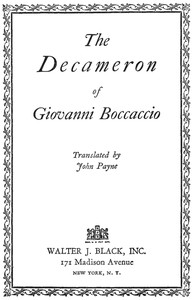
For The Decameron of Giovanni Boccaccio — Reading Companion, the stored edition analysis reports 313,447 words, 22 hr 43 min estimated reading time, and 34 detected text sections.
The text analysis averages about 44.7 words per sentence, while the detected sections provide another way to judge how the source is divided.
Project Gutenberg metadata also associates the work with “Plague -- Europe -- History -- Fiction,” connecting these edition facts with the source record’s subject description.
Explore this collection
These alternatives are selected using recorded categories and estimated reading time.
About 408 minutes
Technology Airships Imagined Futures
93,820 recorded words. 955 minutes difference from this book's estimate.
View Gutenberg source #25102About 337 minutes
Technology Airships Imagined Futures
77,431 recorded words. 1026 minutes difference from this book's estimate.
View Gutenberg source #27690About 325 minutes
Technology Airships Imagined Futures
74,546 recorded words. 1038 minutes difference from this book's estimate.
View Gutenberg source #35593Search stored excerpts and compare books → Choose by your preferences →
Choices use stored catalog measurements. Estimates vary with reading speed. A shared category is a catalog label, not a claim that two books have the same argument or literary quality.
Search reads excerpt text stored with this catalog and links to its associated Gutenberg record. The connection is stored in the site database; this tool does not recheck that every excerpt is word-for-word identical to that external record. Excerpt search does not cover every chapter and does not verify historical publication dates.
Catalog snapshot checked: 2026-09-25. Coverage: 99 public books, 99 available source excerpts.
Calculated from edition completeness, EPUB availability, text structure and catalogue metadata. Not a user rating.
Total of 100 points, scaled to a 2.5-5.0 range. Editions with an empty description or a missing EPUB file are not scored.
Public-domain source text
The source text is kept in the dedicated reader, separate from this catalogue record and its commentary.
The Decameron begins not with a tale but with a description of the 1348 plague in Florence, rendered in unsparing detail: bodies in the streets, abandoned houses, and the breakdown of social bonds. Boccaccio's narrator then introduces ten young people—seven women and three men—who retreat to a country villa and agree to tell stories for ten days. This frame is not merely decorative; it establishes a pattern of escape and reflection that governs the entire work. The first story, about the notorious sinner Ser Ciappelletto who dupes a friar with a false confession and is later venerated as a saint, immediately signals that moral judgments will be complicated. Readers should attend to the interplay between the frame's sober realism and the tales' often playful, ironic tone.
The excerpts reveal that the frame narrative is more than a pretext for storytelling. Boccaccio's description of the plague emphasizes physical and social decay: "the sickness made no stay, but from day to day took on increase" and "such was the multitude of the dead bodies." The ten storytellers are not simply escaping death; they are creating an ordered, artful world in response to chaos. The narrator's voice in the frame is direct and historical, while the tales are introduced with formulaic phrases like "The First Story" and "The Second Story," giving the collection a deliberate, almost liturgical structure. This contrast between the frame's grim reality and the tales' often comic or clever plots is a key feature that shapes how each story is read.
John Payne's 1886 translation preserves a formal, slightly archaic English that suits the work's medieval origins. Phrases such as "he quitteth himself of the penalty" and "she curbeth the extravagant passion" give the prose a rhythmic, almost biblical quality. The translator's note mentions that the original text does not use quotation marks for paragraphs within long quotations, a feature retained here. This stylistic choice can affect how dialogue is parsed; readers may need to track speakers through context. The translation also includes untranslated Italian in one story, with accents added from a modern edition. These textual details reward close attention to language, as Boccaccio's characters often speak in elaborate, courteous terms that contrast with their actions.
The first story sets a pattern: Ser Ciappelletto, a man who "was the worst man ever born," delivers a false confession so convincing that he is declared a saint after death. The narrator does not condemn or endorse this outcome; he simply reports it. This refusal to moralize directly recurs throughout the excerpts. In the story of Gianni di Procida, the lovers are condemned to be burned, but the admiral intervenes, and the king's anger is questioned. The tales often end with a twist or a clever escape, leaving the reader to judge. Boccaccio's narrators rarely offer explicit lessons; instead, they present human behavior—deceit, desire, generosity, cruelty—as it is. This ambiguity is central to the work's enduring appeal.
Several structural patterns emerge from the excerpts. Many stories involve a character who uses wit to escape danger: Abraham the Jew visits Rome and converts after seeing corruption; Melchizedek tells a story of three rings to avoid a trap; a monk escapes punishment by cleverly reproaching his abbot. Love stories often involve obstacles—jealous husbands, angry kings, social barriers—that are overcome through ingenuity or luck. The settings range from courts to convents to public squares, but the focus remains on individual action and consequence. Boccaccio also frequently includes direct speech, giving each character a distinct voice. Readers may notice how the storytellers within the frame sometimes comment on each other's tales, adding another layer of interpretation.
Because the excerpts cover only the opening and a later story, the full arc of the ten days is not visible here. However, the patterns established in these early tales—the frame's tension between order and chaos, the moral ambiguity, the reliance on wit—are likely to recur. Readers should pay attention to how each storyteller's personality might color their chosen tale, and how the collection as a whole balances comedy, tragedy, and social commentary. The Decameron rewards patient reading; its pleasures lie in the details of language and the unexpected turns of its narratives.
There’s something about Boccaccio’s storytellers—people making sense of a broken world through tales—that lingers. I found that same quiet ache in the old ranch's wide-open spaces, where a different kind of frontier asks for its own stories. A familiar feeling, glancing backward. Frances of the Ranges; Or, The Old Ranchman's Treasure — Text and Context feels like an old friend’s letter, unexpectedly waiting.
Build a private reading journal entry for this title.