About 125 minutes
Little Grandmother — Edition Insights
Young Readers Enchanted Adventures
28,749 recorded words. 6 minutes difference from this book's estimate.
View Gutenberg source #25507
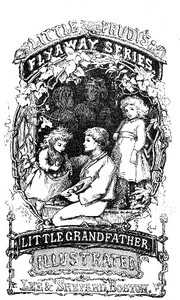
Before opening Little Grandfather — Edition Insights, the edition data offers a quick orientation: 29,945 words, 2 hr 11 min estimated reading time, and 4 detected text sections.
The text analysis averages about 15.1 words per sentence, while the detected sections provide another way to judge how the source is divided.
Project Gutenberg metadata also associates the work with “Christian life -- Juvenile fiction,” connecting these edition facts with the source record’s subject description.
Explore this collection
These alternatives are selected using recorded categories and estimated reading time.
About 125 minutes
Young Readers Enchanted Adventures
28,749 recorded words. 6 minutes difference from this book's estimate.
View Gutenberg source #25507About 118 minutes
Young Readers Enchanted Adventures
26,994 recorded words. 13 minutes difference from this book's estimate.
View Gutenberg source #21471About 153 minutes
Young Readers Enchanted Adventures
35,019 recorded words. 22 minutes difference from this book's estimate.
View Gutenberg source #21464Search stored excerpts and compare books → Choose by your preferences →
Choices use stored catalog measurements. Estimates vary with reading speed. A shared category is a catalog label, not a claim that two books have the same argument or literary quality.
Search reads excerpt text stored with this catalog and links to its associated Gutenberg record. The connection is stored in the site database; this tool does not recheck that every excerpt is word-for-word identical to that external record. Excerpt search does not cover every chapter and does not verify historical publication dates.
Catalog snapshot checked: 2026-09-25. Coverage: 99 public books, 99 available source excerpts.
Calculated from edition completeness, EPUB availability, text structure and catalogue metadata. Not a user rating.
Total of 100 points, scaled to a 2.5-5.0 range. Editions with an empty description or a missing EPUB file are not scored.
Public-domain source text
The source text is kept in the dedicated reader, separate from this catalogue record and its commentary.
Willy Parlin first appears at age three, squeezed into green 'pocket-clothes' with brass buttons and a ruffled collar, studying himself in the glass. His mother has snipped his dark locks so he looks less girlish; his brother Stephen has already nicknamed him a 'Pawnee Indian.' The boy runs to his mother with a quivering lip: 'Isn't I most white, mamma?' That question—part anxiety, part trust—sets the emotional pattern for Sophie May's Little Grandfather (1873), the fifth volume in the Little Prudy's Flyaway Series.
The novel traces Willy's childhood through episodes of sleepwalking, drumming, and small-boy leadership. May builds her story around contrasts: between the mother who gives love 'free and plenteous' and the neighbor who doles it out 'like wedding cake'; between Willy's tender soul and his boisterous energy; between the boy who means to mind his mother and the one who cheats. The excerpts show a world where children's inner lives matter, even when their outer behavior is troublesome.
Mrs. Parlin's affection for Willy is described as 'free and plenteous'—he 'lived on it like daily bread.' This stands in pointed contrast to Elder Lovejoy's wife, who thinks 'kissing and petting were sure to spoil boys' and whose son Isaac 'hadn't been kissed much since he was big enough to go to school.' May does not simply praise one approach; she shows the tension. Willy knows he is 'the very apple of my eye,' yet his mother's open fondness does not prevent his insecurity. When Stephen calls him a 'Pawnee Indian,' the joke 'sank deeper into Willy's tender soul than Stephen suspected.' His question 'Isn't I most white?' reveals a child absorbing adult prejudices and needing reassurance. The mother catches him to her breast, brown fur hat and all, and tells him he is not an Indian and no squaw will carry him off. The scene is tender but also troubling: the comfort relies on the very distinction that caused the hurt.
On his tenth birthday, Willy receives a drum from his grandfather Cheever. He puts 'so much soul into the drumsticks that the noise was perfectly deafening.' He calls the family to meals with 'Hail Columbia' and distracts Quaker Liddy by making her roll pie-crust to 'Yankee Doodle.' When his mother mildly suggests the drum might be better played out of doors, Willy is 'much chagrined'—he had assumed she, with her 'fine musical taste,' must be delighted. The drum also brings social power: the local boys make Willy their captain, demoting Fred Chase to first lieutenant. But Willy immediately 'took the stump' and made a speech in favor of Jock Winter, citing 'All men are born free and equal.' May shows a boy who enjoys prominence but also uses it to advocate for others. The drum's noise is both a source of pride and a strain on household patience—a recurring pattern in Willy's character.
The chapter titled 'Walking in Sleep' (Chapter II) signals that Willy's inner turmoil sometimes escapes his conscious control. Sleepwalking is a physical manifestation of the anxieties and energies that his mother's love cannot fully soothe. The catalog subject 'Sleepwalking -- Juvenile fiction' is unusual for a children's book of this period, and May treats it not as a supernatural event but as a symptom of a sensitive nature. The excerpts do not reveal the content of the sleepwalking episodes, but the placement of this chapter early in the book suggests that Willy's visible high spirits coexist with hidden vulnerabilities. His mother's remark—'I don't know what I shall do with our Willy!'—carries both exasperation and deep attachment. The sleepwalking motif adds a layer of psychological realism to a story that otherwise follows the conventions of moral domestic fiction.
Readers should attend to the small, precise details of domestic life that Sophie May uses to build character: the brass buttons on a green jacket, the purple cap-strings of Mrs. Parlin, the way a drumbeat can organize a household or disrupt it. The novel's title, Little Grandfather, hints at a framing device not fully visible in these excerpts—perhaps the story is being told by an older Willy looking back. The tensions between love and discipline, self-doubt and bravado, are worked out not in grand events but in everyday moments of family life.
Reading Little Grandfather, I kept noticing how Willy’s restless energy is met with such tender patience—his mother’s love steady even when he’s sleepwalking or drumming. That quiet acceptance reminded me of 'Me and Nobbles' — Reading Companion, where childhood’s odd little fancies are handled with the same gentle, unhurried warmth. It feels like remembering someone’s favorite blanket, the way both books hold a child’s oddness without trying to stitch it straight.
Use these questions to collect your thoughts before moving on.