About 208 minutes
The Red Cross Girls with the Russian Army — Context and Discussion
Young Readers Enchanted Adventures
47,731 recorded words. 3 minutes difference from this book's estimate.
View Gutenberg source #22095
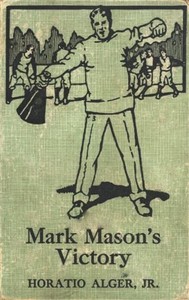
The source record for Mark Mason's Victory — Edition Insights measures this digital text at 48,379 words, 3 hr 31 min estimated reading time, and 7 detected text sections.
The text analysis averages about 10.4 words per sentence, while the detected sections provide another way to judge how the source is divided.
Project Gutenberg metadata also associates the work with “Conduct of life -- Juvenile fiction,” connecting these edition facts with the source record’s subject description.
Explore this collection
These alternatives are selected using recorded categories and estimated reading time.
About 208 minutes
Young Readers Enchanted Adventures
47,731 recorded words. 3 minutes difference from this book's estimate.
View Gutenberg source #22095About 216 minutes
Young Readers Enchanted Adventures
49,648 recorded words. 5 minutes difference from this book's estimate.
View Gutenberg source #30498About 220 minutes
Young Readers Enchanted Adventures
50,426 recorded words. 9 minutes difference from this book's estimate.
View Gutenberg source #21451Search stored excerpts and compare books → Choose by your preferences →
Choices use stored catalog measurements. Estimates vary with reading speed. A shared category is a catalog label, not a claim that two books have the same argument or literary quality.
Search reads excerpt text stored with this catalog and links to its associated Gutenberg record. The connection is stored in the site database; this tool does not recheck that every excerpt is word-for-word identical to that external record. Excerpt search does not cover every chapter and does not verify historical publication dates.
Catalog snapshot checked: 2026-09-25. Coverage: 99 public books, 99 available source excerpts.
Calculated from edition completeness, EPUB availability, text structure and catalogue metadata. Not a user rating.
Total of 100 points, scaled to a 2.5-5.0 range. Editions with an empty description or a missing EPUB file are not scored.
Public-domain source text
The source text is kept in the dedicated reader, separate from this catalogue record and its commentary.
From its opening scene in City Hall Park, Mark Mason's Victory establishes a pattern of contrasts that runs throughout the narrative. A bootblack offers a shine for five cents, and the wealthy Edgar Talbot negotiates the price with his father's approval—a moment that immediately sets thrift against display, and the street boy against the tourist. The novel repeatedly places its young hero, Mark Mason, in situations where his modest station is measured against the expectations of others, whether it is the surprise of a Cleveland lady that a telegraph boy could be entrusted with a thousand-dollar pin, or the wary recognition of a dangerous acquaintance from a smoking car.
The plot hinges on a series of entrusted commissions. Mark, a telegraph boy known to Mr. Swan for only a week, is sent to deliver a diamond pin worth a thousand dollars to Mrs. Loring in Cleveland. The lady herself remarks on the strangeness of selecting “so young a messenger.” Mark’s reply—that a thief would not suspect a boy of carrying valuables—reveals the logic behind the trust. Yet the risk is real: the railroad adventurer Mr. Buffington, who recognizes Mark on the train and later at the Erie Hotel, represents the constant threat of theft. The text underscores that Mark’s reliability is both his strength and his vulnerability.
Alger uses specific locations to frame Mark’s character. The journey from New York to Cleveland is traced through named hotels (the Erie Hotel), streets (Euclid Avenue), and public conveyances (the Fifth Avenue stage, the smoking car). These are not generic backdrops; they are places where Mark’s honesty is tested. In the smoking car he meets Buffington; at the hotel he must decide how to avoid the man while delivering the pin. The address “No. 1001-1/2 Euclid Avenue” is given with precision, grounding the story in a recognizable geography that reinforces the reality of Mark’s errand.
The dialogue in the excerpts is economical but revealing. Mr. Talbot’s motto—“Get things as low as you can. That’s my motto, and that’s the way I got rich”—is a blunt statement of a mercantile philosophy. Mark, by contrast, speaks plainly and without self-promotion. When Mrs. Loring expresses astonishment at his youth, he answers simply, “I am really a telegraph boy. Mr. Swan had known me in that character.” The contrast between the Talbot family’s conspicuous negotiation and Mark’s quiet competence is drawn without authorial comment, allowing the reader to infer the moral hierarchy.
Readers attentive to Alger’s construction will notice how the novel uses small, repeated details—the price of a shine, the name of a hotel, the weight of a pin—to build a world where character is revealed through transaction. Mark’s victory is not a single dramatic event but a series of such moments, each requiring a choice between caution and risk, openness and secrecy. The excerpts offer a clear lens into this pattern without revealing the full resolution.
That rainy afternoon, Mark Mason's Victory kept me company while tea went cold. His quiet honesty under pressure felt less like a lesson, more like a hand on my shoulder. Later, idly wandering the shelf, I pulled down Patty's Social Season — Text and Context and found the same gentle faith—that character, not circumstance, writes the real story.
Build a private reading journal entry for this title.