About 220 minutes
Ben Hadden; or, Do Right Whatever Comes Of It — Story, Setting & Ideas
Young Readers Enchanted Adventures
50,426 recorded words. 4 minutes difference from this book's estimate.
View Gutenberg source #21451
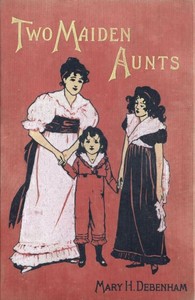
For Two maiden aunts — Reading Notes, the stored edition analysis reports 49,648 words, 3 hr 36 min estimated reading time, and 6 detected text sections.
The text analysis averages about 22.1 words per sentence, while the detected sections provide another way to judge how the source is divided.
Project Gutenberg metadata also associates the work with “Orphans -- Juvenile fiction,” connecting these edition facts with the source record’s subject description.
Explore this collection
These alternatives are selected using recorded categories and estimated reading time.
About 220 minutes
Young Readers Enchanted Adventures
50,426 recorded words. 4 minutes difference from this book's estimate.
View Gutenberg source #21451About 211 minutes
Young Readers Enchanted Adventures
48,379 recorded words. 5 minutes difference from this book's estimate.
View Gutenberg source #30387About 222 minutes
Young Readers Enchanted Adventures
50,937 recorded words. 6 minutes difference from this book's estimate.
View Gutenberg source #21416Search stored excerpts and compare books → Choose by your preferences →
Choices use stored catalog measurements. Estimates vary with reading speed. A shared category is a catalog label, not a claim that two books have the same argument or literary quality.
Search reads excerpt text stored with this catalog and links to its associated Gutenberg record. The connection is stored in the site database; this tool does not recheck that every excerpt is word-for-word identical to that external record. Excerpt search does not cover every chapter and does not verify historical publication dates.
Catalog snapshot checked: 2026-09-25. Coverage: 99 public books, 99 available source excerpts.
Calculated from edition completeness, EPUB availability, text structure and catalogue metadata. Not a user rating.
Total of 100 points, scaled to a 2.5-5.0 range. Editions with an empty description or a missing EPUB file are not scored.
Public-domain source text
The source text is kept in the dedicated reader, separate from this catalogue record and its commentary.
Mary H. Debenham opens Two Maiden Aunts with a landscape that is both specific and atmospheric: an autumn morning 'nearly a hundred years ago,' where 'the meadows looked grey with the heavy dew' and a lad of seventeen gathers mushrooms on a common. The description is unhurried, lingering on the 'showers of dew' shaken from grass and the 'track of footmarks' left behind. This attention to sensory detail—the damp, the pale blue sky through haze, the 'fairy tables' of mushrooms—establishes a world where the natural and the domestic are closely observed. The narrative voice is measured, almost documentary, yet it carries a quiet warmth, as when the boy is seen 'in a fustian jacket and the wide hat which countrymen used to wear in the days of our grandfathers.' The opening thus signals a story grounded in a particular time and place, where the smallest actions—a child leaning over a gate, a hand laid on a shoulder—carry weight.
Debenham’s word choices often do double duty, conveying both action and emotional state. When the boy Godfrey, after a reckless exploit, says to his aunt Betty, 'I wanted to be brave, and I've begun at the wrong end,' the phrase 'wrong end' is deliberately childlike, yet it encapsulates a moral insight. The author avoids melodrama; instead, she lets simple language carry the burden. Similarly, when Angelica confesses, 'I whipped him and put him to bed,' the starkness of the verb 'whipped' contrasts with her trembling hands and the admission that 'he is so little.' The dialogue is spare but telling: Betty’s 'Poor Angel, poor dear, how your hands are shaking' reveals empathy without overt commentary. Debenham trusts the reader to infer the sisters’ internal conflict from their halting exchanges and physical reactions.
The conversations in the excerpts are marked by a formal politeness that masks deep feeling. When the stranger, Captain Maitland, offers help, Angelica responds with a 'grave curtsey' and the measured words, 'Thank you, sir, for your kindness in bringing our nephew home.' The courtesy is a shield. Later, Betty’s invitation to 'have a glass of elder wine' is both hospitable and hesitant, revealing her inexperience. The captain’s reply—'I shall hope to avail myself of your kind hospitality another day'—is equally formal, yet his 'sly smile' and the offer of his hand to little Nancy introduce a note of warmth. Debenham uses these exchanges to show how the sisters, thrust into adult roles, navigate social expectations while their true feelings—anxiety, gratitude, wonder—flicker beneath the surface.
Setting in Two Maiden Aunts is never merely decorative. The opening description of the common, with its 'cows and horses and geese wander[ing] about pretty much as they chose,' suggests a world of natural freedom, yet the blackberries are 'damp' and the season 'pretty nearly over.' This mingling of abundance and decay mirrors the children’s situation: they are orphans, but not without resources. The 'small gabled house' with its 'paddock' and 'autumn flowers' hanging their heads is a place of contained order, soon to be disrupted. Debenham’s descriptive passages often carry a moral undertone: the mist that 'veiled' the sky, the 'heavy dew' that weighs down flowers—these details create an atmosphere of uncertainty and latent change, preparing the reader for the emotional trials that follow.
Debenham employs a narrative structure that leaves much unsaid, relying on implication and juxtaposition. The chapter titles—'The Aunts,' 'The Nephew,' 'The First Day'—are deceptively simple, yet they promise a gradual unfolding. Within scenes, the author uses pauses and silences to powerful effect. After Betty rushes indoors to tell her news, she 'stopped short suddenly, and after a minute sat down on the stairs and dropped her chin in her hands.' The action is small, but the pause signals a shift in mood. Similarly, when Angelica emerges from punishing Godfrey, the sisters 'sprang to meet each other'—the physical urgency contrasting with their halting speech. These structural choices—the withheld revelation, the delayed response—invite the reader to attend to what is not said, making the emotional stakes feel both real and earned.
Readers approaching Two Maiden Aunts will find a story that rewards attention to its quiet details. Debenham’s prose is economical but never flat; her characters reveal themselves through what they do and do not say. The excerpts suggest a narrative that values moral seriousness without sacrificing warmth, and that trusts its audience to read between the lines. For those interested in late-Victorian children’s literature that treats its young protagonists with respect, this novel offers a nuanced portrait of responsibility and growth.
I finished the notes on Two Maiden Aunts the other evening, and for days afterward I kept thinking about how quietly those women changed themselves, the way small habits of kindness can reshape a whole home. That tender patience reminded me of another story I’d set aside—'Me and Nobbles' — Reading Companion—where the same gentle noticing of a child’s world stays with you long after the last page. It felt like remembering something true.
Answer a few questions and save a private reflection on this device.