About 254 minutes
Hildegarde's Holiday: A Story for Girls — Context and Discussion
Young Readers Enchanted Adventures
58,391 recorded words. 6 minutes difference from this book's estimate.
View Gutenberg source #24826
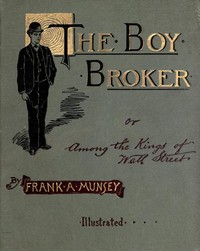
The catalog record for The Boy Broker; Or, Among the Kings of Wall Street — A Closer Reading provides practical reading context through 59,602 words, 4 hr 20 min estimated reading time, and 9 detected text sections.
The text analysis averages about 15.8 words per sentence, while the detected sections provide another way to judge how the source is divided.
Project Gutenberg metadata also associates the work with “Conduct of life -- Juvenile fiction,” connecting these edition facts with the source record’s subject description.
Explore this collection
These alternatives are selected using recorded categories and estimated reading time.
About 254 minutes
Young Readers Enchanted Adventures
58,391 recorded words. 6 minutes difference from this book's estimate.
View Gutenberg source #24826About 250 minutes
Young Readers Enchanted Adventures
57,291 recorded words. 10 minutes difference from this book's estimate.
View Gutenberg source #33390About 248 minutes
Young Readers Enchanted Adventures
56,928 recorded words. 12 minutes difference from this book's estimate.
View Gutenberg source #26538Search stored excerpts and compare books → Choose by your preferences →
Choices use stored catalog measurements. Estimates vary with reading speed. A shared category is a catalog label, not a claim that two books have the same argument or literary quality.
Search reads excerpt text stored with this catalog and links to its associated Gutenberg record. The connection is stored in the site database; this tool does not recheck that every excerpt is word-for-word identical to that external record. Excerpt search does not cover every chapter and does not verify historical publication dates.
Catalog snapshot checked: 2026-09-25. Coverage: 99 public books, 99 available source excerpts.
Calculated from edition completeness, EPUB availability, text structure and catalogue metadata. Not a user rating.
Total of 100 points, scaled to a 2.5-5.0 range. Editions with an empty description or a missing EPUB file are not scored.
Public-domain source text
The source text is kept in the dedicated reader, separate from this catalogue record and its commentary.
Frank A. Munsey's The Boy Broker; Or, Among the Kings of Wall Street (1888) opens with a preface that explicitly states its didactic aim: to teach boys manliness and self-reliance through an engaging story rather than a lecture. The narrative voice that follows is a curious blend of earnest moralizing and brisk adventure, shifting between passages of explicit advice and scenes of rapid action. Munsey's prose is direct and unadorned, favoring dialogue that carries the plot forward—as when Bob Hunter's characteristic mannerisms and Tom Flannery's street slang give the text a colloquial energy. The author's dedication to his father, acknowledging the value of 'rigid new england discipline,' sets a tone of retrospective seriousness that occasionally surfaces in the story's commentary on conduct.
Munsey's preface lays out his theory of boy's fiction: plot and action are merely the 'setting' for a moral 'gem,' and the hero should serve as an unconscious model for the reader. This intention is visible throughout the excerpts, where characters explicitly discuss right conduct. When Herbert Randolph asks the captured fence Gunwagner whether his ill-gotten money has brought happiness, the old man's only reply is a 'silent tear'—a moment of sentiment that reinforces the book's moral arithmetic. Yet Munsey is careful to balance such scenes with action, as when Bob Hunter's loyalty to Tom Flannery is rewarded with praise: 'Tom, you've got more sand than I thought you had.' The lesson is embedded in the characters' relationships, not stated as a rule.
The excerpts show Munsey relying heavily on dialogue to differentiate his characters and drive the plot. Bob Hunter speaks in a distinctive, colloquial register—'Excitin'! Well, wasn't it, though!'—while Herbert Randolph uses more formal, measured language: 'We do not feel uneasy about your so called friends.' This contrast in speech patterns underscores their different backgrounds and roles. Tom Flannery's dialect ('I thought you was done for, sure') adds a layer of authenticity to the street scenes. Munsey also uses dialogue to convey information quickly, as when Gunwagner threatens to raise a dozen friends, and Herbert counters by mentioning Mortimer's betrayal. The exchanges are terse, often confrontational, and keep the narrative moving at a brisk pace.
The excerpts reveal a notable shift in pacing between the preface and the later chapters. The preface is slow, reflective, and argumentative, explaining the author's philosophy at length. In contrast, the action sequences—such as the binding of Gunwagner and the subsequent conversation—are compressed and immediate. Munsey uses short paragraphs and rapid dialogue to create tension: 'Now every hope had failed the old man. He saw nothing but Sing Sing before him.' The chapter break at 'CHAPTER XVIII. TOM FLANNERY IS HUNGRY.' introduces a domestic interlude that slows the pace again, focusing on Bob's breakfast profits and Tom's loyalty. This alternation between high-stakes confrontation and quieter character moments gives the narrative a varied rhythm, though the moral commentary never fully disappears.
Readers attentive to the book's construction will notice how Munsey's preface shapes the reading experience: the moral lessons are never far from the surface, but they are delivered through action and dialogue rather than sermonizing. The author's claim that boys are 'imitative by nature' suggests that Herbert Randolph is meant to be a model worth following. Whether the story succeeds as a disguised lecture or a genuine adventure depends on how much weight the reader gives to the author's stated intentions versus the lively, slang-filled exchanges that propel the plot.
I keep thinking about how The Boy Broker trades earnest lessons for the raw rush of street life, and it reminded me of something quieter—that old clergyman’s vacation, where warmth slowly unhurries a heart. Both leave a gentle ache, like remembering a conversation that didn’t need to end. Father Brighthopes; Or, An Old Clergyman's Vacation — Context and Discussion lingers that way for me.
Your answers remain private and are stored only in this browser.