About 224 minutes
Frontier Boys on the Coast; Or, In the Pirate's Power — Key Ideas to Explore
Exploration Survival Adventure Tales
51,413 recorded words. 1 minutes difference from this book's estimate.
View Gutenberg source #25473
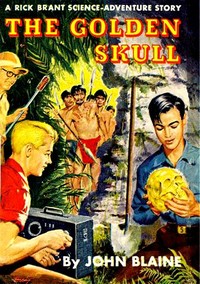
The source record for The Golden Skull: A Rick Brant Science-Adventure Story — Edition Insights measures this digital text at 51,566 words, 3 hr 45 min estimated reading time, and 5 detected text sections.
The text analysis averages about 10.9 words per sentence, while the detected sections provide another way to judge how the source is divided.
Project Gutenberg metadata also associates the work with “Adventure stories,” connecting these edition facts with the source record’s subject description.
Explore this collection
These alternatives are selected using recorded categories and estimated reading time.
About 224 minutes
Exploration Survival Adventure Tales
51,413 recorded words. 1 minutes difference from this book's estimate.
View Gutenberg source #25473About 228 minutes
Exploration Survival Adventure Tales
52,219 recorded words. 3 minutes difference from this book's estimate.
View Gutenberg source #34728About 221 minutes
Exploration Survival Adventure Tales
50,795 recorded words. 4 minutes difference from this book's estimate.
View Gutenberg source #36320Search stored excerpts and compare books → Choose by your preferences →
Choices use stored catalog measurements. Estimates vary with reading speed. A shared category is a catalog label, not a claim that two books have the same argument or literary quality.
Search reads excerpt text stored with this catalog and links to its associated Gutenberg record. The connection is stored in the site database; this tool does not recheck that every excerpt is word-for-word identical to that external record. Excerpt search does not cover every chapter and does not verify historical publication dates.
Catalog snapshot checked: 2026-09-25. Coverage: 99 public books, 99 available source excerpts.
Calculated from edition completeness, EPUB availability, text structure and catalogue metadata. Not a user rating.
Total of 100 points, scaled to a 2.5-5.0 range. Editions with an empty description or a missing EPUB file are not scored.
Public-domain source text
The source text is kept in the dedicated reader, separate from this catalogue record and its commentary.
The opening chapter of The Golden Skull places readers inside a sweltering freighter cabin, where Rick Brant and Don Scott are absorbed in a three-dimensional chess game, oblivious to the tropical heat. The scene establishes the boys' intense rivalry and their scientist father's influence, while archaeologist Dr. Anthony Briotti steps on deck to view Corregidor, a landmark from his wartime naval service. The narrative quickly introduces a shadowy movement and a sense of unease, hinting at danger. The catalog subjects list "Adventure stories," "Philippines -- Juvenile fiction," and "Scientists -- Juvenile fiction," but the excerpts show a story grounded in specific, concrete details: the chessboard, the freighter's flaking paint, and Briotti's personal memories of commanding a destroyer. These details ground the adventure in a particular time and place, rather than generic exoticism.
The excerpts convey a strong sense of place through sensory details: the "heaviness of the tropical heat" penetrating steel, the "faint light of a new moon" over Corregidor, and the "rocky fortress" looming at Manila Bay. The setting is not merely a backdrop but actively shapes the characters' actions—the heat forces them into shorts, and the historical significance of Corregidor triggers Briotti's war memories. The catalog subject "Philippines -- Juvenile fiction" is thus realized through specific geographical and historical references, such as the mention of Corregidor and Manila Bay, rather than generic tropical descriptions. The narrative also includes local terms like "Ifugao" and "Igorot" in chapter titles, indicating a deliberate engagement with Philippine ethnography, though the excerpts do not reveal how accurately these are portrayed.
The excerpts reveal character through action and dialogue rather than exposition. Rick and Scotty are shown as competitive but collaborative, absorbed in chess while ignoring Briotti. Later, their confrontation with Lazada and Nast showcases a calculated, almost theatrical threat: Rick calmly discusses killing or crippling Nast, using a sniper as leverage. The dialogue is direct and tense, with lines like "He wants to kill Mr. Nast. I don't think we should kill Mr. Nast, do you?" This contrasts with the catalog subject "Scientists -- Juvenile fiction," as the boys' scientific background is not evident in these passages—they act more like amateur detectives or adventurers. The archaeologist Briotti, though a scientist, is briefly shown as a former naval commander, blending scientific and military identities. The excerpts do not clarify how their scientific training informs their actions.
The excerpts build suspense through incomplete information and looming threats. Briotti's disappearance is mentioned but not shown; the boys confront Lazada and Nast without proof, relying on bluff and implied violence. The presence of bodyguards with pistols and the mention of a sniper create a tense standoff. The catalog subject "Archaeologists -- Juvenile fiction" is relevant only through Briotti's role, but the excerpts focus on his abduction rather than archaeological work. The golden skull itself is not described in the provided text, leaving its significance unclear. The narrative structure—starting with a chess game, moving to a shadowy figure, then a dinner confrontation—suggests a pattern of calm interrupted by danger, typical of adventure serials. However, without more text, the resolution of these conflicts remains unknown.
Readers approaching The Golden Skull should note that the excerpts offer only a narrow window into the story's plot and themes. The catalog subjects suggest a science-adventure blend, but the available text emphasizes confrontation and setting over scientific inquiry. The golden skull itself, the titular object, is absent from these passages, and its role—whether artifact, treasure, or MacGuffin—is not revealed. Pay attention to how the authors balance the boys' youthful bravado with the real dangers of head-hunters and political intrigue, and consider whether the Philippine setting is treated with cultural specificity or as a generic adventure locale.
Reading about Rick and Scotty slipping through the jungle made me think of long summer afternoons, how certain chases feel both urgent and perpetual. That same sense of a world beyond the map drifted through The Two Supercargoes; Or, Adventures in Savage Africa — Edition Insights, where distance itself seemed to hum with unspoken promise. I remember turning those pages slowly, almost reluctantly, as if speed might break the spell. The golden skull felt like an old friend’s signal, flickering across decades.
Build a private reading journal entry for this title.