About 257 minutes
The Children of Wilton Chase — Themes and Context
Historical Psychological Social Fiction
59,044 recorded words. 32 minutes difference from this book's estimate.
View Gutenberg source #26409

This digital edition of Dave Porter in the Gold Fields; Or, The Search for the Landslide Mine — Key Ideas to Explore is described by source-level measurements including 66,397 words, 4 hr 49 min estimated reading time, and 7 detected text sections.
The text analysis averages about 12.4 words per sentence, while the detected sections provide another way to judge how the source is divided.
Project Gutenberg metadata also associates the work with “Western stories,” connecting these edition facts with the source record’s subject description.
Explore this collection
These alternatives are selected using recorded categories and estimated reading time.
About 257 minutes
Historical Psychological Social Fiction
59,044 recorded words. 32 minutes difference from this book's estimate.
View Gutenberg source #26409About 257 minutes
Historical Psychological Social Fiction
58,884 recorded words. 32 minutes difference from this book's estimate.
View Gutenberg source #37176About 254 minutes
Historical Psychological Social Fiction
58,244 recorded words. 35 minutes difference from this book's estimate.
View Gutenberg source #36671Search stored excerpts and compare books → Choose by your preferences →
Choices use stored catalog measurements. Estimates vary with reading speed. A shared category is a catalog label, not a claim that two books have the same argument or literary quality.
Search reads excerpt text stored with this catalog and links to its associated Gutenberg record. The connection is stored in the site database; this tool does not recheck that every excerpt is word-for-word identical to that external record. Excerpt search does not cover every chapter and does not verify historical publication dates.
Catalog snapshot checked: 2026-09-25. Coverage: 99 public books, 99 available source excerpts.
Calculated from edition completeness, EPUB availability, text structure and catalogue metadata. Not a user rating.
Total of 100 points, scaled to a 2.5-5.0 range. Editions with an empty description or a missing EPUB file are not scored.
Public-domain source text
The source text is kept in the dedicated reader, separate from this catalogue record and its commentary.
Edward Stratemeyer's Dave Porter in the Gold Fields (1914) moves its characters through a landscape defined by mining camps, mountain trails, and sudden storms. The narrative rhythm alternates between westward travel by horse and foot, confrontations with rivals like Link Merwell and Job Haskers, and encounters with wild animals—a mountain lion, a grizzly bear—that mirror the dangers of the search itself. The old miner Tom Dillon, who guides the party, provides a store of local knowledge and anecdote, his speech marked by dialect and a wry humor that contrasts with the boys' eager questions.
The journey from Butte to Black Cat Camp is described in stages: a noon departure, a rest at Robby's settlement, and a push onward after supper. Stratemeyer marks each leg with specific times and distances, grounding the adventure in a practical geography. The party passes mine after mine, watching quartz-crushers and ore extraction, while Tom Dillon notes how the state has "settled putty fast" in twenty-five years, with towns springing up "like toadstools." This attention to the changing frontier—railroads, lights in the mountains—gives the setting a historical texture. The boys' observations are filtered through their inexperience: Phil asks about wild animals, Roger hopes to confront the antagonists at Black Cat Camp, and Dave listens to Dillon's bear story. The movement is not just physical but social, as each stop brings new information or a missed connection.
Light appears repeatedly as a marker of time and mood. The journey begins "clear and warm" at noon; later, the sun sinks "behind the great mountains in the west." As darkness falls, the party sees "the twinkling lights of many a mining town and camp shining out in the mountains and the valleys below." These lights contrast with the earlier description of a Montana where, decades before, one could ride all night and see no light. Weather also punctuates the narrative: the heat of midday makes the boys perspire freely, and a storm is foreshadowed in the chapter titles ("Caught in a Storm" appears twice). The storm is not merely atmospheric but a plot device that isolates characters and forces them into caves or shelters, heightening the sense of vulnerability.
Stratemeyer uses animal encounters to break the travel rhythm and introduce peril. Tom Dillon's story of being trapped on a ledge with a grizzly—unable to pass, unable to shoot—is a miniature of the novel's larger standoffs. The bear anecdote is told in response to Phil's question about hunting, and Dillon's punchline ("I didn't do it—your uncle, Maurice Harrison, done it") ties the past to the present. Later, a chapter titled "Dave and the Mountain Lion" promises a direct confrontation. These episodes serve as set pieces that test the characters' resourcefulness and reinforce the theme of survival in a harsh environment. The animals are not merely obstacles but symbols of the untamed frontier that the boys must navigate.
Conversations in the excerpts often function as information dumps, but Stratemeyer varies the speakers to avoid monotony. Tom Dillon delivers facts about mining claims ("over fifteen thousand minin' claims staked and recorded") and gold output ("the output runs up into the millions every year") in a colloquial voice that feels natural. The boys' responses—"Then I trust we locate the Landslide Mine, and that it proves a bonanza"—are earnest and forward-looking. The dialogue also reveals character: Roger is eager and optimistic, Phil curious about hunting, Dave thoughtful and observant. When the party inquires about Abe Blower and finds no news, the information is withheld, creating a gap that drives the plot forward. The old miner's remark that they'll "hear from them at Black Cat Camp" sets up the next scene as a potential confrontation.
Readers attentive to the novel's structure will notice how Stratemeyer layers travel, dialogue, and hazard in a repeating cycle. The journey is never straightforward: each stage brings a delay, a story, or a threat. The gold mine itself remains a distant goal, less important than the process of getting there. This emphasis on the search rather than the discovery gives the book its momentum, and the careful placement of storms, animals, and missed connections keeps the reader oriented in a landscape that is both real and symbolic.
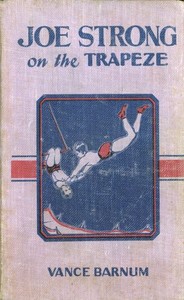
There’s something about the way Dave Porter’s hunt for that landslide mine keeps circling back to small, sharp moments—a flash of light on rock, a horse spooked in the dark—that made me think of Joe Strong on the Trapeze; Or, The Daring Feats of a Young Circus Performer — A Closer Reading. Both feel like waiting for the next quiet imbalance, the instant before things tilt.
Build a private reading journal entry for this title.