About 215 minutes
The Ranch Girls and Their Great Adventure — Edition Insights
Historical Psychological Social Fiction
49,282 recorded words. 1 minutes difference from this book's estimate.
View Gutenberg source #34927
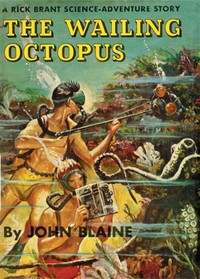
The source record for The Wailing Octopus: A Rick Brant Science-Adventure Story — A Reader’s Guide measures this digital text at 49,626 words, 3 hr 36 min estimated reading time, and 5 detected text sections.
The text analysis averages about 12.0 words per sentence, while the detected sections provide another way to judge how the source is divided.
Project Gutenberg metadata also associates the work with “Treasure troves -- Juvenile fiction,” connecting these edition facts with the source record’s subject description.
Explore this collection
These alternatives are selected using recorded categories and estimated reading time.
About 215 minutes
Historical Psychological Social Fiction
49,282 recorded words. 1 minutes difference from this book's estimate.
View Gutenberg source #34927About 222 minutes
Historical Psychological Social Fiction
51,013 recorded words. 6 minutes difference from this book's estimate.
View Gutenberg source #28642About 207 minutes
Historical Psychological Social Fiction
47,435 recorded words. 9 minutes difference from this book's estimate.
View Gutenberg source #37271Search stored excerpts and compare books → Choose by your preferences →
Choices use stored catalog measurements. Estimates vary with reading speed. A shared category is a catalog label, not a claim that two books have the same argument or literary quality.
Search reads excerpt text stored with this catalog and links to its associated Gutenberg record. The connection is stored in the site database; this tool does not recheck that every excerpt is word-for-word identical to that external record. Excerpt search does not cover every chapter and does not verify historical publication dates.
Catalog snapshot checked: 2026-09-25. Coverage: 99 public books, 99 available source excerpts.
Calculated from edition completeness, EPUB availability, text structure and catalogue metadata. Not a user rating.
Total of 100 points, scaled to a 2.5-5.0 range. Editions with an empty description or a missing EPUB file are not scored.
Public-domain source text
The source text is kept in the dedicated reader, separate from this catalogue record and its commentary.
The Wailing Octopus opens with a Sky Wagon droning over Caribbean waters, and the narrative voice immediately establishes a dual register: technical precision in piloting and diving equipment coexists with the easy banter between Rick Brant and Don Scott. The dialogue—"No faith. That's the trouble with you" / "No logic, that's the trouble with you"—reveals a friendship built on affectionate mockery, a pattern that recurs throughout the excerpts. This voice is neither purely instructional nor purely conversational; it shifts fluidly between explaining a compass course or a camera case's pressure valve and trading jokes about the pronunciation of "cay." The result is a tone that feels both informative and intimate, as if the reader is included in the expedition's private exchanges.
The novel's pacing is closely tied to the characters' physical environment. On the surface—aboard the Water Witch or in the Sky Wagon—the narrative moves at a relaxed, expository tempo. Conversations about film stock, rest intervals, and "establishing shots" unfold without urgency. But the moment the boys descend underwater, the prose contracts. Sentences shorten. Action verbs dominate: "Rick felt the warning constriction that told him he had only minutes left. He pulled down the reserve lever of his tank and touched Scotty's arm. He hooted twice for the ascent." The rhythm mimics the compressed time of a dive, where every second counts. This alternation between leisurely preparation and compressed crisis gives the story a distinctive pulse, one that rewards attention to the transitions between chapters and scenes.
Rick's underwater camera is more than a prop; it becomes a structuring device for the reader's attention. The excerpts describe in detail its stainless steel and Lucite case, the gear arrangement for focus, the light meter, and the inner-tube valve for pressure compensation. This technical specificity grounds the adventure in a believable, hands-on world. But the camera also shapes how events are presented. Rick photographs Scotty entering the water, then repositions to capture the same action from a different angle. He pans across the wreck, reverses to film Scotty approaching, and keeps "his camera grinding" during a surprise encounter with a grouper. The narrative itself adopts a cinematic quality—cutting between wide shots and close-ups, establishing shots and reaction shots—as if the reader is watching a film being made in real time.
The dialogue between Rick and Scotty carries much of the characterization. Their exchanges are laced with playful logic-chopping—"A cay is something that follows an O, as in okay"—and a shared vocabulary of diving and science. Yet the narrative voice also reveals their competence through understatement. When Rick "hooted twice for the ascent," no explanation is given; the signal is assumed to be understood. Similarly, the description of the camera case assumes familiarity with terms like "aperture" and "infrared light." This confidence in the reader's intelligence is a hallmark of the series' voice. The prose does not pause to define every term, but trusts that context will carry meaning. The result is a narrative that feels both expert and accessible, never condescending.
Readers approaching The Wailing Octopus will find that its pleasures lie as much in the texture of its prose as in the plot's twists. Pay attention to how the narrative shifts gears between the banter of the boat and the silent urgency of the reef. Notice, too, how the camera's presence turns every dive into a potential frame. The story rewards those who read with an eye for craft, not just for treasure.
Reading about Rick’s underwater silence, I remembered the summer I held my breath in a library corner, the hum of fluorescent lights like current. That same hush filled me with The Brothers Karamazov—a pause before turbulence, not gear but guilt, my own heartbeat loud in the stillness. The Brothers Karamazov — Edition Insights made me feel that again, a familiar weight in my chest.
Save your reaction, strongest insight, and memorable passage.