About 200 minutes
Hoofbeats on the Turnpike — Background and Themes
Historical Psychological Social Fiction
45,800 recorded words. 7 minutes difference from this book's estimate.
View Gutenberg source #34691
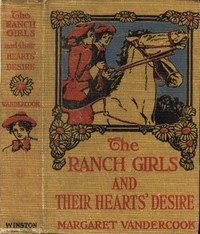
The source record for The Ranch Girls and Their Heart's Desire — Key Ideas to Explore measures this digital text at 47,435 words, 3 hr 27 min estimated reading time, and 5 detected text sections.
The text analysis averages about 20.2 words per sentence, while the detected sections provide another way to judge how the source is divided.
Project Gutenberg metadata also associates the work with “Western stories,” connecting these edition facts with the source record’s subject description.
Explore this collection
These alternatives are selected using recorded categories and estimated reading time.
About 200 minutes
Historical Psychological Social Fiction
45,800 recorded words. 7 minutes difference from this book's estimate.
View Gutenberg source #34691About 199 minutes
Historical Psychological Social Fiction
45,697 recorded words. 8 minutes difference from this book's estimate.
View Gutenberg source #34403About 215 minutes
Historical Psychological Social Fiction
49,282 recorded words. 8 minutes difference from this book's estimate.
View Gutenberg source #34927Search stored excerpts and compare books → Choose by your preferences →
Choices use stored catalog measurements. Estimates vary with reading speed. A shared category is a catalog label, not a claim that two books have the same argument or literary quality.
Search reads excerpt text stored with this catalog and links to its associated Gutenberg record. The connection is stored in the site database; this tool does not recheck that every excerpt is word-for-word identical to that external record. Excerpt search does not cover every chapter and does not verify historical publication dates.
Catalog snapshot checked: 2026-09-25. Coverage: 99 public books, 99 available source excerpts.
Calculated from edition completeness, EPUB availability, text structure and catalogue metadata. Not a user rating.
Total of 100 points, scaled to a 2.5-5.0 range. Editions with an empty description or a missing EPUB file are not scored.
Public-domain source text
The source text is kept in the dedicated reader, separate from this catalogue record and its commentary.
The novel opens with a twilight ride across a prairie, a scene that establishes both the physical landscape and the emotional terrain Jacqueline Kent must navigate. The description of the sky 'banked with gold and rose and purple clouds' and the earth showing 'the same colors in the yellow sand of the desert spaces, the wide fields of purple clover, and the second blooming of the prairie roses' creates a harmony between the natural world and the human story. This opening image of riding side by side, studying the landscape, sets a pattern of movement and observation that recurs throughout the excerpts.
The title of the first chapter, 'The Branch of the Tree,' introduces a metaphor that may resonate with Jacqueline's return to the Rainbow ranch after her husband's death. The image of a branch suggests both connection to a larger whole and the possibility of breaking away. The novel's structure alternates between intimate conversations and public performances, such as the Woman's Club speech in Chapter X, where Jacqueline faces an audience of several hundred persons.
The excerpts show a deliberate alternation between private, outdoor settings and formal indoor gatherings. The opening chapter places Jacqueline and Jim Colter on horseback at twilight, moving slowly and studying the landscape. This leisurely pace contrasts with the later scene in Laramie, where Jacqueline steps onto a platform and faces 'an audience of several hundred persons.' The shift from the wide prairie to the confined stage mirrors Jacqueline's transition from personal grief to public advocacy.
In the carriage ride to the Woman's Club, the conversation among Jacqueline, Frieda, Jim Colter, and Professor Russell reveals the tensions between private support and public doubt. Frieda's chatter about Jacqueline's speech and her own disapproval highlights the domestic sphere's intrusion into political ambition. The novel thus moves between these two poles: the open range, where Jacqueline feels at home, and the club room, where she must prove herself.
The first chapter's title, 'The Branch of the Tree,' may be read as a structural motif. In the opening paragraph, the man and woman ride 'side by side,' suggesting a partnership that is both intimate and purposeful. Later, Jacqueline is described as having 'always loved the old ranch better than any place in the world,' and Jim Colter notes that 'when human beings are hurt they follow the instincts of the homing birds who seek the nest.' The branch thus symbolizes both rootedness and the potential for new growth.
This image reappears in the description of Jacqueline's appearance at the club: she wears 'a pearl and amethyst star which her husband had given her years before,' a piece of jewelry that connects her past to her present. The star, like a branch, is a small part of a larger whole, hinting at the way personal history informs public action. The novel may use such recurring details to weave together Jacqueline's private and public selves.
The excerpts reveal a narrative that shifts not only between locations but also between characters' viewpoints. The opening chapter is told from a close third-person perspective focused on Jacqueline and Jim, but later scenes include Frieda's voice and her husband's amused reactions. In the carriage, Frieda's dialogue is rendered in a 'hushed voice' meant only for Professor Russell, creating a sense of eavesdropping on private conversations.
This technique allows the reader to see Jacqueline from multiple angles: as a grieving widow, a determined speaker, and a sister subject to Frieda's affectionate criticism. The novel's structure thus moves between external action and internal reflection, with the landscape serving as a constant backdrop. The 'branch of the tree' may also refer to the narrative's branching paths, following different characters' reactions to Jacqueline's choices.
One of the most striking moments in the excerpts is Jacqueline's simple statement: 'I never learned during the years of my married life in England to feel that I was anything but a stranger there.' This sentence carries the weight of her entire backstory, summarizing years of displacement in a few words. The novel's structure often relies on such concise revelations, where a single line opens a window into a character's history.
Similarly, Frieda's remark that 'one never has been able to count upon what Jack would think or do' encapsulates the unpredictability that drives the plot. The excerpts suggest that the novel builds its drama not through elaborate action but through the accumulation of such telling statements. The reader is left to infer the full story from these fragments, much as Jacqueline must piece together her new life from the remnants of the old.
Readers approaching this novel should attend to the way Vandercook uses landscape and movement to mirror Jacqueline's inner journey. The recurring image of the branch, the shifts between private and public spaces, and the weight given to individual sentences all contribute to a narrative that is both a western and a psychological portrait. The excerpts offer a glimpse of a woman balancing grief, ambition, and family loyalty, but the full arc of her 'heart's desire' remains to be discovered in the complete text.
I have often thought that Jacqueline Kent, returning to Wyoming with her branch of the tree, carries a quiet defiance which Pauline Lister, in Marjorie Dean, College Junior — Key Ideas to Explore, knows too—that strange balance of loyalty and ambition, where the open land and the college hall ask similar things of a girl, each in their own season.
Answer a few questions and save a private reflection on this device.